


Introduction
In the first place, cancer is a big medical topic, so in this cancer overview I will briefly discuss what can be done to minimize the risks of getting it. Notably, cancer is a disease where one cell type within an organ has degenerated to the point where these cells have lost their ability to stop dividing. Consequently, as these cells clone themselves, they invade first locally and eventually spread within the entire body via the blood vessels and the lymphatic system. In other words, as they do this, clusters of new daughter tumors, called “metastases”, are formed. Certainly, these are colonies of the original tumor and under the microscope their cells look the same way as the original tumor. This is how the pathologist can diagnose cancer from a cell sample of a tumor.
Cancer metastases
In the meantime the cancer eventually invades vital organs such as the liver, the lungs, the bone marrow, brain, the kidneys or the adrenal glands. In the long run this destroys the healthy tissue and changes the metabolism leading to nausea, weight loss and weakness. Ultimately this state of weakness worsens and leads to death as a result of liver failure, lung failure, bone marrow failure or cerebral edema (in the case of brain metastases).
The good news is that cancer rates in the US are down compared to the past.
Certainly, the p53 cancer gene seems to be crucial for the development of cancer. Recently it has been detected that elephants have many more copies of this suppressor gene and scientist are trying to utilize this knowledge in new cancer curing approaches: https://nethealthbook.com/news/new-findings-about-cancer-gene/
Chronic inflammation
As I pointed out in my video on the home page entitled “New approach to medicine” cancer is one of the conditions where there is a strong association to chronic inflammation in the body. Even the Wall Street Journal caught on regarding this connection (see article under Ref. 17). Also, it is mentioned that omega-3-fatty acids from fish are beneficial in preventing many cancers, but so are vitamin D3 and many other anti-inflammatory supplements. Not every cancer is equally common. There are some cancers that are rare such as liver cancer or testicular cancer (see table below). Other cancers are very common such as lung cancer, prostate cancer or breast cancer. To clarify, to keep statistics on this over the decades, cancer clinics and cancer control agencies compile average annual rates of new cancers. This tells them whether there is a trend with rates going up or down.
Smoking as an example of how chronic inflammation can cause lung cancer
I am coming back to the observation that chronic inflammation can cause cancer. With the illustration below I am showing that chronic exposure to smoking causes a transition into chronic bronchitis and eventually emphysema. As cigarette smoke also contains carcinogen (=cancer producing chemicals) a close link has been established between cigarette smoking and coming down with lung cancer. Similar transitions have been observed with cancer of the cervix and exposure to human papilloma virus infections that by themselves can be asymptomatic.
Chronic inflammation can cause cancer
Eventually the chronic inflammation of the tissue around the cervix leads to cancer of the cervix. Cancer of the pancreas is another example. Here there is a transition from chronic pancreatitis (often started by exposure to chronic alcohol abuse) to cancer of the pancreas. Finally there is the example of the transition from liver cirrhosis to liver cancer. The more severe cirrhosis of the liver is and the more chronic inflammation there is in the liver, the higher the risk to develop liver cancer.
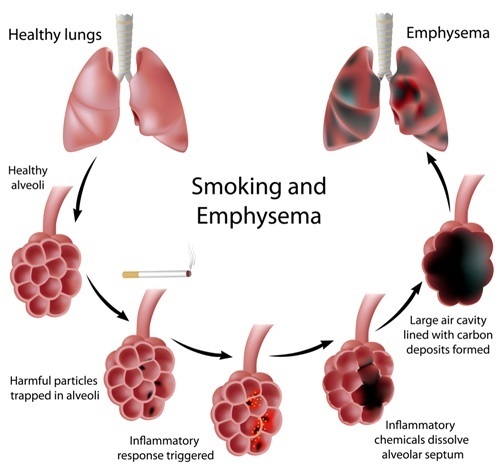
Cancer Overview (Chronic Inflammation Leads To Cancer)
Prevention
There is a lot that can be done to prevent cancer.
1. It starts with good nutrition. Cut out sugar and starches and you remove one of the major engines that oxidizes the LDL cholesterol and that leads to inflammation eventually leading to cancer after several decades of exposure. One component, vitamin D is particularly important in cancer prevention. Food alone cannot achieve the blood levels that are necessary to prevent cancer, you need to take vitamin D3 supplements every day: https://nethealthbook.com/news/enough-vitamin-d-needed-to-reduce-cancer-risk/
2. Exercise on a regular basis so that oxygen penetrates all of the tissues right down to the cellular level. This prevents glycolysis in cells that do not get enough oxygen from prolonged sitting and inactivity. Mortality is getting significantly reduced when cancer patients exercise.
3. Take antioxidant vitamins and supplements. This stabilizes cell metabolism and strengthens the immune system (see link under “Related Topics” below).
4. Combat stress by relaxing, yoga, self hypnosis. It stabilizes your hormones.
5. When we get older and reach male and female menopause, we require hormone analysis and replacement of missing hormones by bioidentical hormones.See the “Anti-aging medicine for women and men“ link under “Related Topics” below.
6. Vitamin D3 reduces cancer rates: https://nethealthbook.com/news/vitamin-d-reduces-cancer-rates/
7. There may be some merit in taking green tea extract as a supplement: https://nethealthbook.com/news/green-tea-extract-kills-oral-cancer-cells/
8. Vitamin C has merit in both prevention and as an adjunct to cancer treatment as discussed here: https://nethealthbook.com/news/cancer-patients-need-vitamin-c/
References
1. JK McLaughlin et al. Int J Cancer 1995 Jan 17; 60(2): 190-193.
2. GN Wogan Semin Cancer Biol 2000 Jun 10(3): 201-210.
3. L Garfinkel et al. Stat Bull Metrop Insur Co 1999 Jul-Sep;80(3): 23-32.
4. G Torres-Mejiha et al. Int J Cancer 2000 Sep 15;87(6): 869-873.
5. M Feuring-Buske et al. Ann Hematol 2000 Apr 79(4): 167-174.
6. RJ Kreitman et al. J Clin Oncol 2000 APR 18(8): 1622-36.
7. SA Rosenberg et al. Ann Surg 1998 Sep 228(3): 307-319.
8. K Fujita et al. Clin. Cancer Res 1995 May 1(5): 501-507.
9. J van der Zee et al. Lancet 2000 Apr1; 355(9210): 1119-1125.
10. H Ge and J Huang J Surg Oncol 2000 Jul 74(3): 193-195.
11. P Hillemanns et al. Int J Cancer 2000 March 1; 85(5): 649-653.
12. K Moghissi et al. Eur J Cardiothorac Surg 1999 Jan 15(1): 1-6.
13. Cancer: Principles &Practice of Oncology.4th edition. Edited by Vincent T. DeVita, Jr. et al. Lippincott, Philadelphia,PA, 1993. Chapter 70:”Unsound methods of cancer treatment”, page 2734 -2747.
14. Cancer: Principles&Practice of Oncology. 5th edition, volume 1. Edited by Vincent T. DeVita, Jr. et al. Lippincott-Raven Publ., Philadelphia,PA, 1997. The data from the tables on p. 236-237 were condensed and the figures rounded off to the nearest full number.
15. C Dong et al. Int J Cancer 2001 Apr 1;92(1):144-150
16. “What if… cancer were cured?” by David Godkin, The Medical Post, Vol.47, No.7, April 19, 2011: page 44 and 45.
17. The New Science Behind America’s Deadliest Diseases
18. Suzanne Somers: “Bombshell. Explosive medical secrets that will redefine aging”. Chapter 15: Nicholas Gonzales, p. 265-278. Crown Publishing, 2012.
19. Suzanne Somers: “Bombshell. Explosive medical secrets that will redefine aging”. Chapter 11: An interview with Russell Blaylock”, p. 184-207. Crown Publishing, 2012.